Human pathogenic bacteria are able to colonize and persist in crop plants. In consequence, consumption of raw produce might cause food-borne diseases. Contamination with human pathogens may happen throughout the whole production chain, including pre- and post-harvest stages. Among human pathogens, the non-typhoid Salmonella enterica is a prevalent cause of food-borne disease outbreaks in the European Union. Furthermore, salmonellosis was the most commonly reported gastrointestinal infection in humans. S. enterica was reported to utilize different strategies to colonize plant hosts, including colonization of the phyllosphere, which is highlighted by the provided image.
The electron microscopy image shows S. enterica serovar Typhimurium strain 14028s on the leaf surface of Solanum lycopersicum, more precisely, a stoma. The localization of S. Typhimurium 14028s in captivity of stomatal openings indicates its potential to attach to leaf surfaces and colonize plants by internalization via natural openings. Once S. enterica has found its way into internal plant tissues, it may translocate from leaves to systemic parts of the plant. This harbors the greatest risk for consumers, since Salmonella may reach the edible parts of the plant, e.g., fruits.
The image was taken by Michel Schrader in collaboration with Dr. Mathias Müsken at the Central Facility for Microscopy of the Helmholtz Centre for Infection Research (HZI). It was part of Mr. Schrader’s Master’s thesis to understand the colonization routes of Salmonella enterica and persistence in tomato plants, supervised by Dr. Jasper Schierstaedt and Prof. Adam Schikora at the Julius Kühn-Institut (JKI), Federal Research Centre for Cultivated Plants.
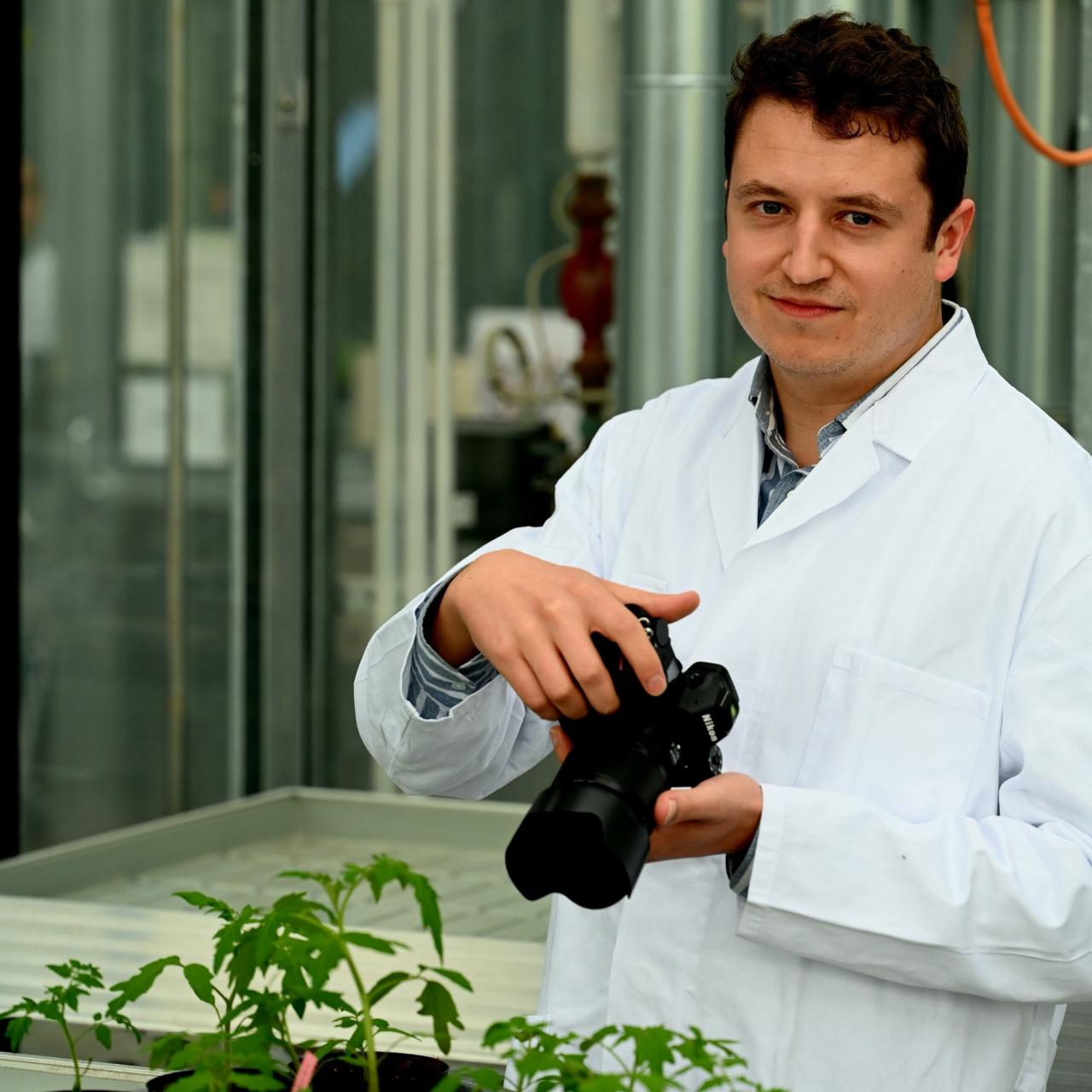 Michel Schrader is a German researcher who studied Biology at the Technical University of Braunschweig. He has a strong focus on microbial ecology and microbiology, including research on interactions between human pathogens and plants. He applied this knowledge during his Master’s thesis at the Julius Kühn-Institut (JKI), Federal Research Centre for Cultivated Plants, in the group of Prof. Adam Schikora, on colonization of plants by the human pathogenic bacterium Salmonella enterica.
Currently, Mr. Schrader is a PhD student at the JKI Institute for Epidemiology and Pathogen Diagnostics, investigating the microbial dynamics of peat-reduced substrates and peat alternatives for professional horticulture. This project targets at enhancing plant resilience in peat-reduced growth systems with microbial inoculants by utilizing the plant growth-promoting activities of bacterial isolates from such alternative substrates. Additionally, he analyzes their antagonistic potential against S. enterica and bona fide phytopathogens. His goal is to assemble microbial consortia, incorporating plant-beneficial as well as antimicrobial activities of bacterial inoculants.
The front covers of the ISME publications are updated every year. If you would like to see your photo featured, make sure to submit your microscopy image to the ISME Photo Competition, which will open on 14 October and close on 4 November 2026. To stay up to date, follow ISME on social media